
Russia sanctions: what the new UK restrictions mean


The UK’s Russia sanctions announcement of 1 October combines restrictions on people and organisations with measures directed at ships. The shared word “sanctions” does not mean that each target faces the same rules.
The Foreign, Commonwealth & Development Office’s 1 October announcement describes a package of 31 measures. Its stated objectives include restricting revenue supporting Russia’s war in Ukraine and disrupting disinformation networks.
These are the government’s stated purposes. An announcement of restrictions is not, by itself, evidence of how much revenue they will prevent or how effectively they will be enforced.
Minister for Europe Lord Wood of Anfield said in the announcement that the measures target both revenues sustaining Russia’s aggression and perpetrators of crimes against Ukrainian civilians. That is the minister’s account of the package, not an independent finding by this newspaper.
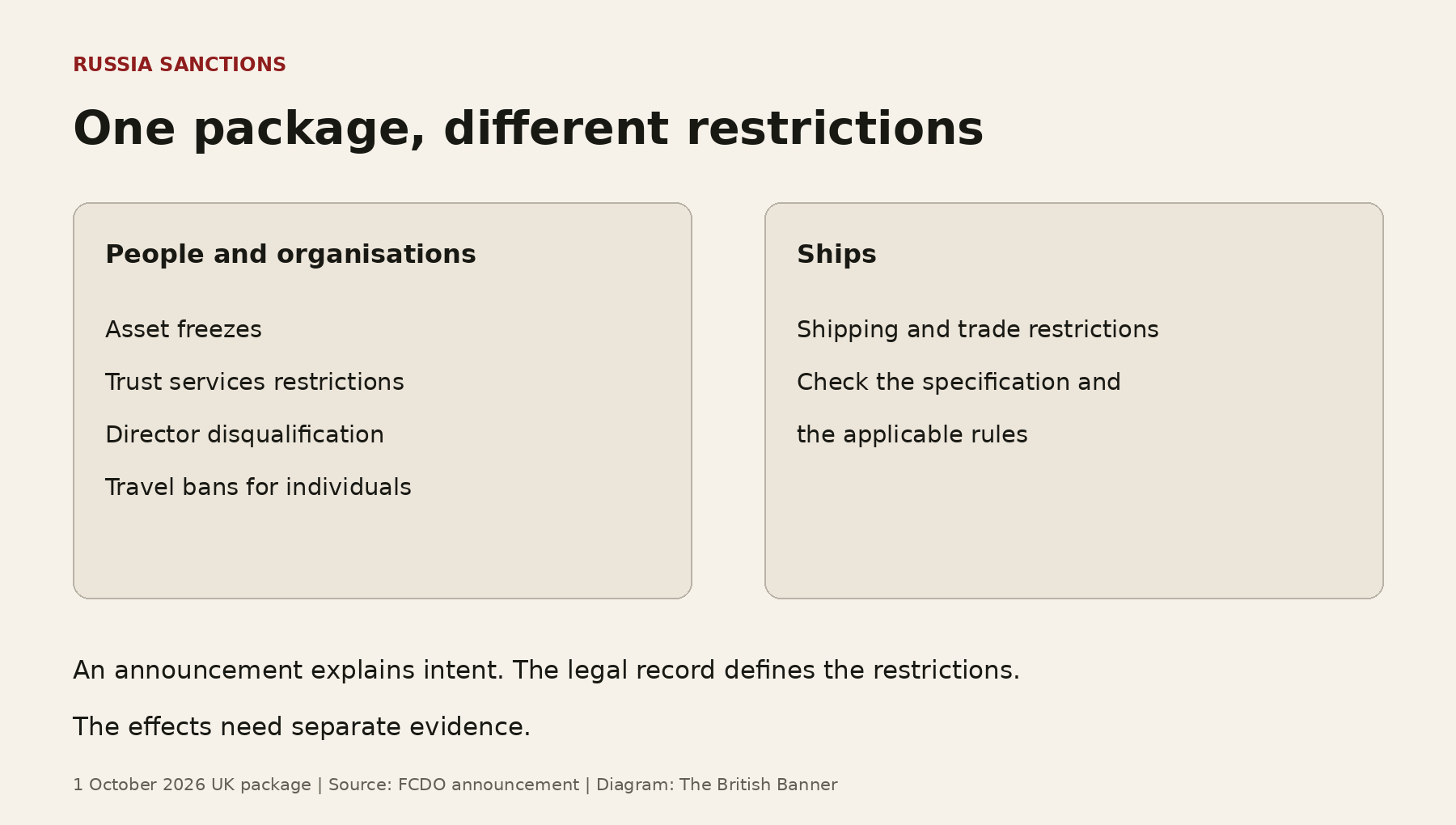
Text version: people and organisations face asset freezes, trust services restrictions and director disqualification, with travel bans for individuals. Ships face shipping and trade restrictions. The legal record defines the rules; effects need separate evidence.
Russia sanctions: different targets, different restrictions
The department says the package covers 23 individuals and entities and eight ships. It says the individuals and entities face asset freezes, trust services sanctions and director disqualification sanctions, with travel bans also applying to the individuals. The ships face shipping and trade sanctions.
That distinction matters when reading a headline total. A ship targeted under shipping rules is not simply another person added to an asset-freeze list. The relevant designation and the legislation determine what a restriction does.
This article does not repeat the department’s allegations against named individuals as independently established findings. The government’s announcement and the official designation record are the sources for understanding whom it has targeted and why.
What an asset freeze means under Russia sanctions
Guidance from the Office of Financial Sanctions Implementation, part of HM Treasury, explains that shares can qualify as funds and must be frozen when owned, held or controlled by a designated person. Without an applicable exception or licence, dealing with frozen shares is prohibited.
The example illustrates the practical importance of the rules: they constrain transactions involving funds and economic resources. Readers should not turn the phrase “asset freeze” into an assumption that a criminal court has convicted the person concerned.
The guidance also discusses restrictions on making funds available to designated people. It contains provisions concerning ownership and control, payment chains and exceptions. A list of names alone cannot answer every question about whether a particular transaction is permitted.
Russia sanctions have a defined reach
OFSI says UK financial sanctions apply to people within UK territory and territorial waters, and to UK persons wherever they are. Its guidance discusses a connection to the UK when considering enforcement, which it calls a “UK nexus”.
It would be wrong to translate that into a claim that a UK announcement automatically prevents every transaction everywhere in the world. Equally, a business operating abroad cannot assume that its distance from the UK removes all relevant obligations.
The October announcement also refers to targeted, time-limited licensing arrangements for liquefied natural gas connected with Japan and South Korea’s energy security. That is a reminder that restrictions and permitted activities can coexist within a sanctions framework.
Read the Russia sanctions record, not only the announcement
The Russia designation and notices page was updated on 2 October, after the announcement, with two ship specifications revoked and remade and two administrative amendments. This article explains the 1 October package, not a complete current register.
The official Russia financial-sanctions guidance and current notices are the starting points for checking the rules. Designations and guidance can change after a news release.
OFSI expressly says its frequently asked questions are supplementary guidance, not legal advice. For an organisation facing an actual transaction, checking the current legislation, designation, ownership position and any relevant licence is different work from reading a news summary.
For the wider public, the key distinction is simpler: what the government intends, what the restrictions legally prohibit, and what their measured effects turn out to be are separate questions. The first can be reported now. The last needs evidence beyond the announcement.
Featured photo: Chris McAndrew / UK Parliament, CC BY 3.0. Official portrait of Lord Wood of Anfield, March 2018; landscape crop.
For related context, read our explainer on NATO Article 5 and collective defence.