
NATO Article 5: what collective defence commits members to do


NATO Article 5 is the collective-defence clause of the North Atlantic Treaty. An armed attack against one or more members in the treaty's defined area is treated as an attack against them all. The resulting promise is to assist the member or members attacked.
Explainer | Sources checked 4 October 2026.
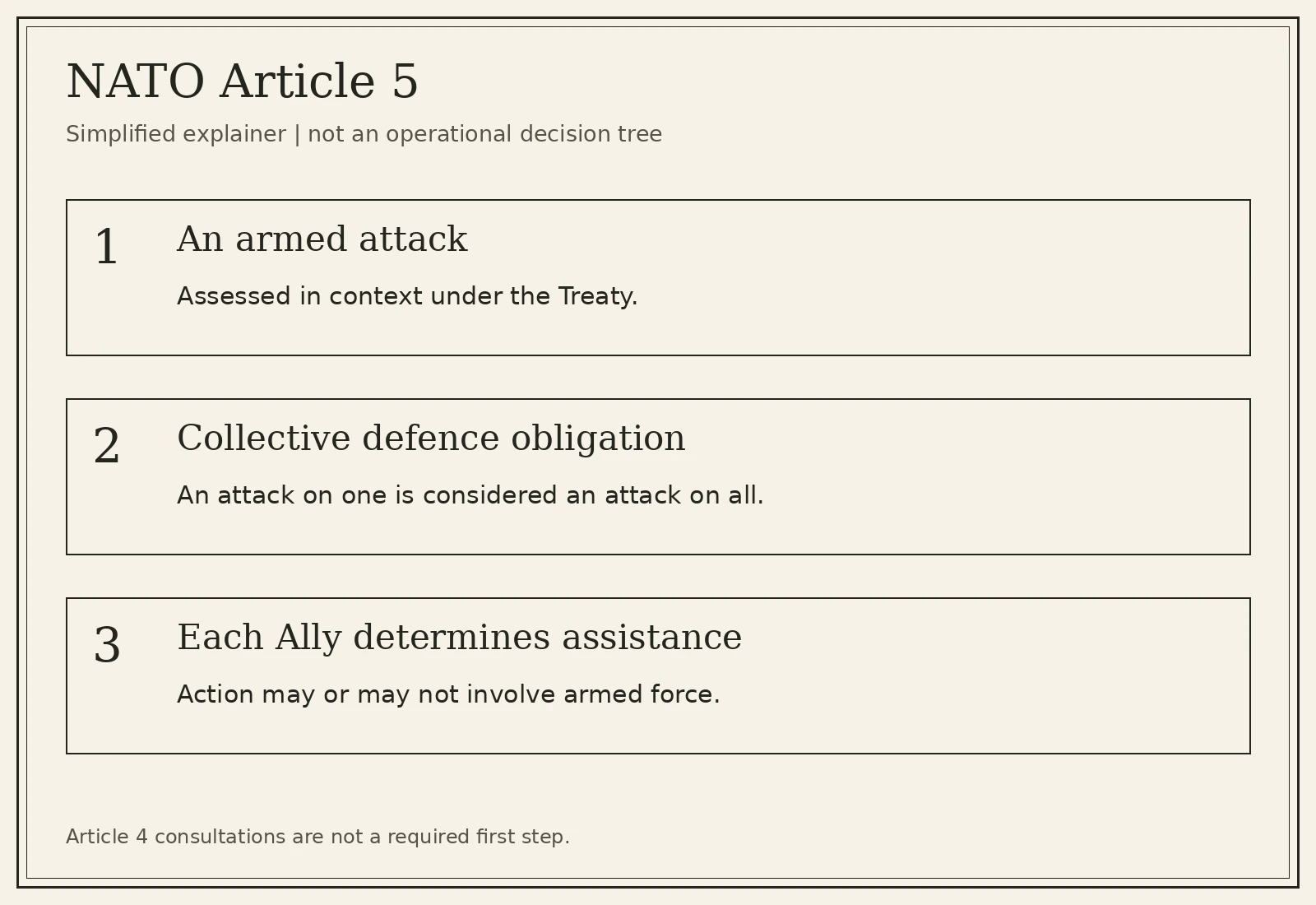
Text version of the diagram: NATO Article 5 overview: armed attack, collective defence and assistance chosen by each Ally.
NATO Article 5: an obligation with choices
The treaty says each member will take action it considers necessary, including the use of armed force, to restore and maintain security. That wording matters. Armed force is a possible response, not a requirement that every ally send the same forces or take the same action.
NATO's explanation says assistance may or may not involve armed force. Members determine how they fulfil the obligation, in consultation and coordination with one another. Article 11 also places implementation within members' constitutional processes.
Article 4 is different
Article 4 provides for consultation when a member believes its territorial integrity, political independence or security is threatened. Consultation is not itself an Article 5 decision. NATO says Article 4 talks are neither a necessary precondition for Article 5 action nor an indication that Article 5 is being considered.
The scope of NATO Article 5
Article 6 defines the geographic scope of the collective-defence commitment. Article 5 is therefore not a blanket promise covering every incident involving a member anywhere in the world.
NATO says whether an incident amounts to an armed attack must be assessed case by case. Its guidance discusses cyber and hybrid attacks as well as conventional military attacks. The attacked ally must request or consent to collective action under Article 5.
This is an explanation of the treaty, not a prediction of how allies would respond to a particular future crisis. Headlines about consultations, deployments and collective defence should be read with those distinctions in mind.
Reading NATO Article 5 in context
The treaty is more than its most quoted clause. Article 1 commits members to settle international disputes peacefully and avoid force inconsistent with the United Nations' purposes. Article 3 concerns maintaining and developing the capacity to resist armed attack. Together, these provisions help explain why collective defence involves preparation and consultation as well as the possibility of military action.
Article 5 expressly refers to the right of individual or collective self-defence recognised in Article 51 of the UN Charter. It also requires reporting an armed attack and resulting measures to the UN Security Council. Those references matter because the promise is framed within an international legal system, not as an unrestricted permission to use force.
The national and collective levels
For readers, NATO Article 5 is best understood by separating the shared obligation from each member’s chosen response.
NATO's account distinguishes the obligation of each ally from the alliance's coordinating role. Allies consult through the North Atlantic Council, the organisation's main political decision-making body. An attacked member can identify its needs while other members offer assistance. Coordination does not prevent individual members from taking bilateral or unilateral actions consistent with the commitment.
The treaty does not prescribe one fixed procedure for triggering assistance. NATO's guidance says the two relevant conditions are an armed attack, assessed in good faith, and the attacked ally's request for or consent to collective action. A political statement by allies may accompany that assessment, but the legal text and the organisation's explanation should be read separately from shorthand descriptions in a headline.
Three questions for a report about the alliance
First, is the report about a threat being discussed, or an attack said to fall within collective defence? Second, does it describe a commitment to assist or a specific national decision about forces? Third, is its claim about treaty coverage grounded in the geography and circumstances of the incident? These distinctions do not settle every dispute, but they help keep a statement of principle separate from the decisions needed to put it into practice.
Sources
Related explainers
- What is NATO Article 5? The collective defence clause explained as Black Sea attacks test the alliance
- How a bill becomes law: from parliamentary proposal to implementation
- Lower inflation: why it does not necessarily mean lower prices