
VAR checks: why the referee does not always visit the monitor

VAR checks do not automatically mean the referee must visit the pitch-side monitor. The IFAB protocol distinguishes a check from a review, and allows some decisions to be made using information supplied by the VAR.
Explainer | Sources checked 4 October 2026.
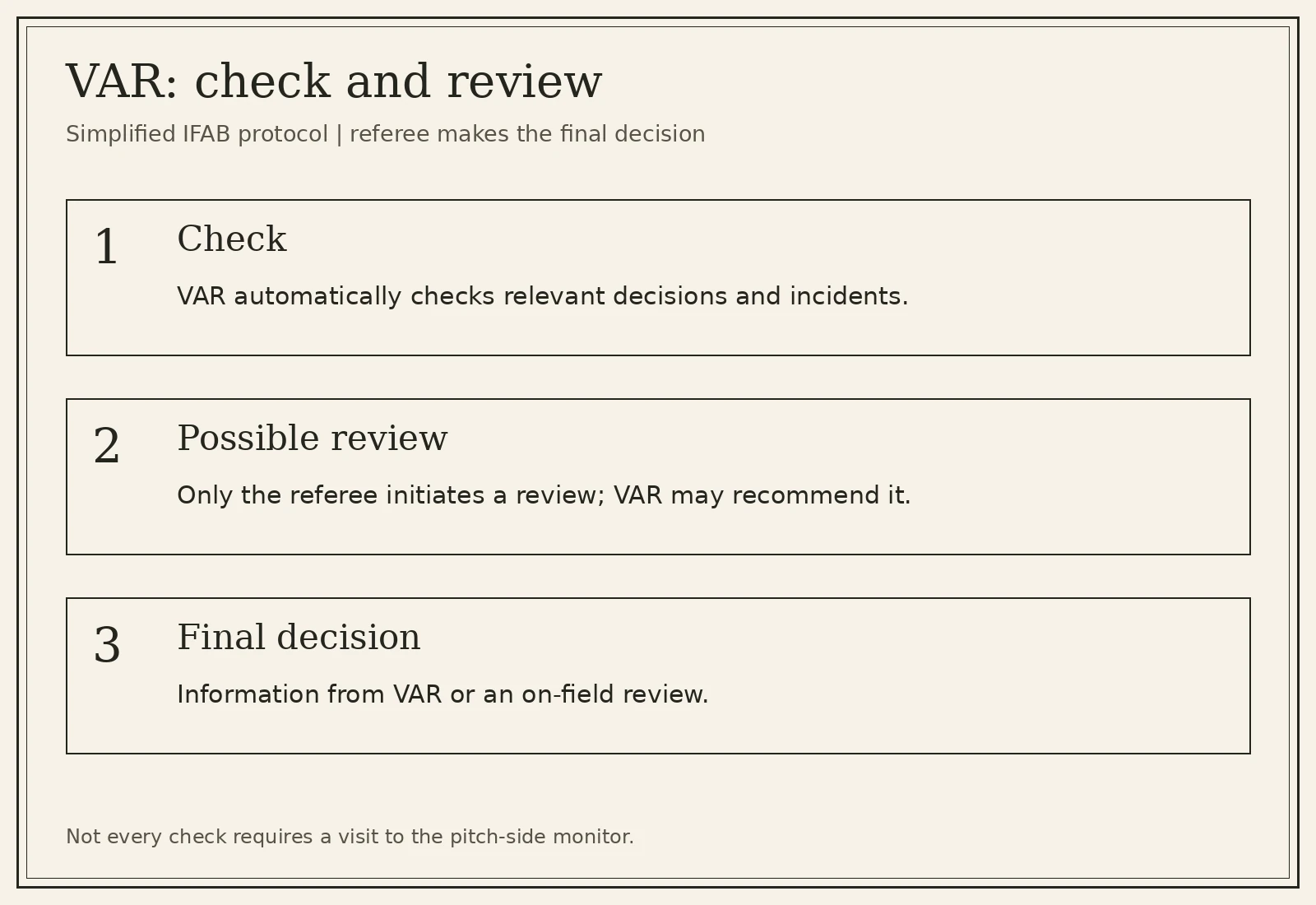
Text version of the diagram: VAR checks overview: an automatic check, a possible review and the referee final decision.
VAR checks may end without a review
Video officials check footage for potential reviewable incidents. If the footage does not show a clear and obvious error or a serious missed incident, the original decision stands. The protocol describes this as a silent check, though officials may sometimes communicate confirmation.
If a check indicates a probable clear and obvious error or serious missed incident, the VAR tells the referee. Only the referee can initiate a review, and the referee retains the final decision. Players and coaches do not need to request a review and must not try to influence the process.
VAR checks: facts and judgement are different
For subjective decisions, such as the intensity of a challenge or whether a player interfered with an opponent at offside, an on-field review is appropriate. For factual matters, such as a player's offside position or whether an offence occurred inside or outside the penalty area, a VAR-only review is usually appropriate.
The referee can still use an on-field review for a factual matter where doing so helps manage the players or communicate the decision. The absence of a monitor visit is therefore not, by itself, evidence that the procedure has failed.
Slow motion is not a universal answer
The protocol says slow motion should generally be used for facts such as the position of a player or point of contact. Normal speed should be used to judge the intensity of an offence. A replay that establishes where contact happened may not, on its own, settle how forceful the challenge was.
This is a guide to the check-and-review process, not a judgement on a particular match incident. Competition-specific implementation and changes to reviewable categories must be checked against the rules applying to that match.
VAR checks do not transfer the referee's responsibility
The protocol requires an initial decision from the referee and other match officials. They are not permitted to leave an incident undecided simply so the video official can decide it later. Allowing play to continue is itself a decision that may be reviewed where the protocol permits. The VAR assists rather than replaces the on-field referee.
This helps explain why the initial call matters. Video is not a fresh refereeing of every incident. The protocol says the original decision is not changed unless the review clearly shows a clear and obvious error. A serious missed incident provides another route to intervention, but it is still governed by the protocol rather than an unrestricted second opinion.
A signal has a specific meaning
During a delayed restart for a check, the referee holds a finger to the earpiece and extends the other arm. A review involves the television signal. The final decision belongs to the referee whether it follows a monitor visit or information from the video official. Viewers should distinguish those stages rather than treating every communication through the headset as a completed review.
The footage and its limits
VAR checks depend on the available footage and the type of decision being considered.
The VAR has access to television footage and can use different angles and replay speeds. The referee can request further angles or speeds during a review. More footage can clarify a fact, but the protocol's distinction between factual and subjective questions remains: the position of contact and the judgement about an offence are not automatically the same question.
There is no time limit in the protocol for the review process; it gives accuracy priority over speed. That does not mean a long delay is proof that the eventual decision is right or wrong. To assess a particular incident, readers need the relevant footage, the applicable rule and a clear account of the decision under review. This article makes no such match-specific finding.
Check which version applies
IFAB publishes the protocol and law changes, while competition arrangements can matter to implementation. Do not assume an old explainer describes every later season or every competition. This guide confines itself to the documented check-and-review distinction and leaves the reviewable-category details to the rules applying to a particular match.
Sources
Related explainers
- Lower inflation: why it does not necessarily mean lower prices
- Local library services: beyond the bookshelf and into digital borrowing