
Moved home? Check your electoral registration, not just your address book
Practical explainer: electoral registration after moving home.
Moving home changes more than the address on your bills. If you want to vote from your new address, electoral registration belongs on the moving checklist too.
GOV.UK’s registration guidance says you need to register again if you change your name, address or nationality. Registering once does not mean that the electoral register follows you automatically to each new home.
Normally, you do not need to register separately for every election. A change in your details is the reason to take action, rather than waiting for the next campaign to begin.
Start with the official electoral registration service
The online service can put you on the electoral register or update your details by registering again. It also allows you to opt out of the open register, the version that is available for anyone to buy.
GOV.UK says the application usually takes about five minutes. It asks for a National Insurance number, but says you can still register if you do not have one. Do not treat the absence of that number as a reason to abandon the official process without checking the alternatives.
If you are unsure whether you are already registered, contact your electoral registration office. A remembered application, an old polling card or another household member’s registration is not a substitute for checking your own position.
Check eligibility separately
Registration and eligibility to vote in a particular election are related but distinct questions. The official voting guide begins by directing readers to check which elections they can vote in before moving through registration and voting arrangements.
Do not assume that the rules for one election apply to every other election, or that guidance for one part of the UK is identical elsewhere. The registration service identifies separate processes for some overseas voters and for Northern Ireland.
For readers who prefer paper, GOV.UK provides a paper-registration route for England, Wales and Scotland. It identifies a different form and destination for Northern Ireland. Use the route linked from the official service rather than a form saved from an old move.
Electoral registration is not the whole voting plan
Once registered, you can consider voting in person, by post or by proxy. Those choices have their own application processes and deadlines. Updating your registration should not be read as confirmation that a previous postal or proxy arrangement has been carried over.
The government guide also directs voters to check what identification they need for voting in person. That question is separate from whether an application to join the electoral register has been made.
No election date or deadline is assumed here. If a poll is approaching, check that election’s published dates and the relevant application deadlines with the electoral registration office. A general guide cannot tell you whether a last-minute application will be processed in time for a particular poll.
Electoral registration: privacy and help
GOV.UK explains that your name and address will appear on the electoral register, and on the open register unless you opt out. It also points to a different anonymous-registration process where there are safety concerns.
That is a reason to read the options, rather than treating registration as a box to tick without checking its consequences. The electoral registration office can help with registration questions and accessibility needs.
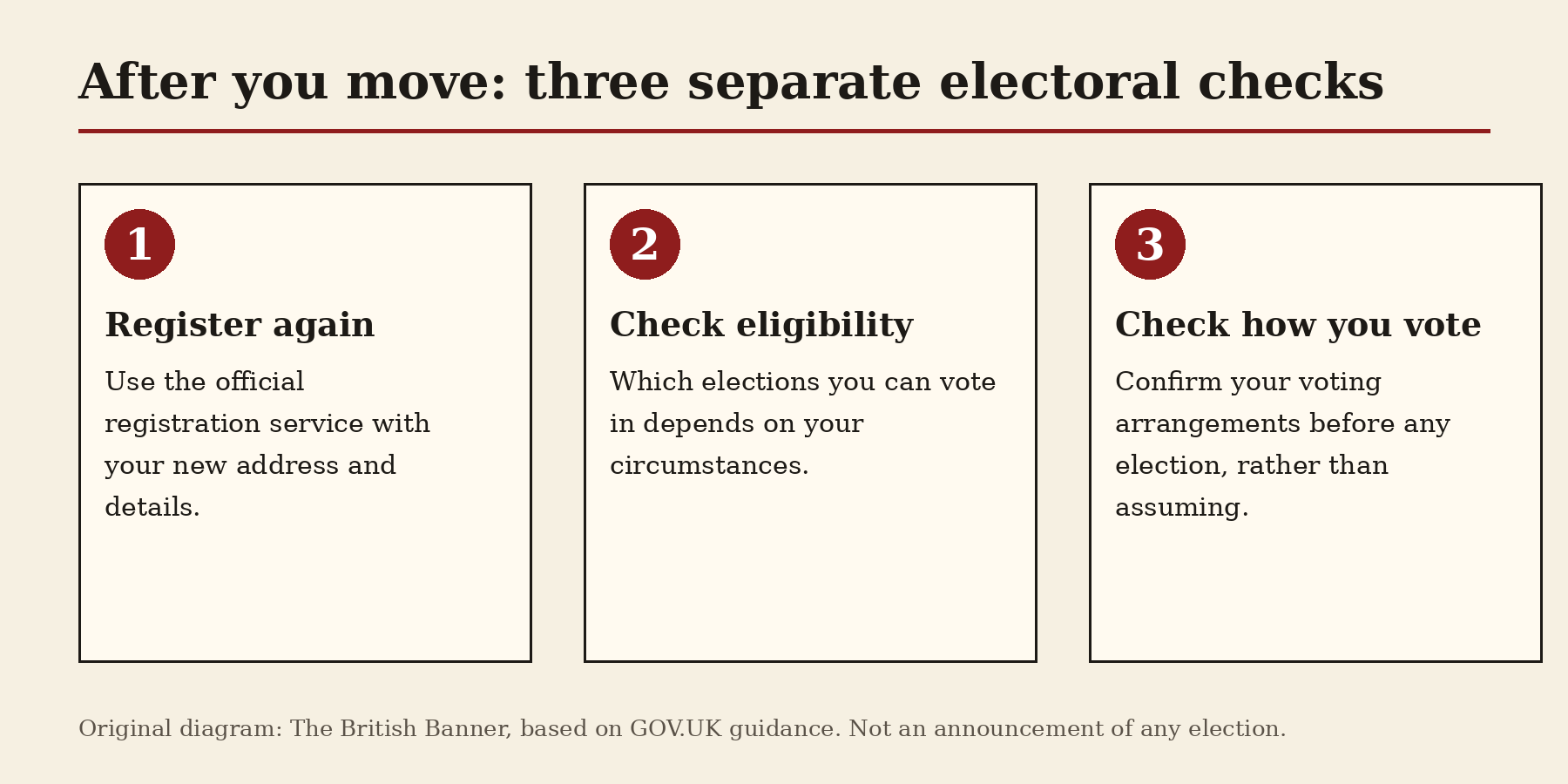
The practical rule after a move is straightforward: check eligibility, register again with the new details, then check how you intend to vote. These are separate steps, and completing one does not prove that all the others are settled.
Featured photo: secretlondon123 / Wikimedia Commons, CC BY-SA 2.0. A polling-station sign photographed in 2009. Archive image, not an announcement of a current election; cropped to landscape.

For related context, read our explainer on how a bill becomes law.